

English Prepositions for Shopping: Confused by Tiny Words? Simplified
Have You Ever Forgotten One Tiny Word While Shopping? Let’s look at English Prepositions for Shopping

You know exactly what you want to say.
You know the vocabulary.
You know the grammar.
But then you walk into a store and suddenly wonder…
Do I say look at or look for?
Pay by or pay with?
Try on or try out?
One small preposition can completely change the meaning
Let’s go shopping!
Why Shopping Prepositions Feel So Confusing
Many English learners translate directly from their first language.
Unfortunately, prepositions rarely translate perfectly.
Instead of asking:
“Which preposition should I memorize?”
Ask yourself:
“What is happening in this situation?”
Every preposition tells a small story.
It describes movement, direction, purpose, location, comparison, or method.
Once you understand the story, choosing the correct preposition becomes much easier.
In the Store
Think of in as being inside a space.
Examples:
✅ I’m in the supermarket.
✅ She’s in the clothing store.
✅ We spent two hours in the mall.
Visual idea:
🏬 → You are inside.
Whenever you’re surrounded by the place, use in.
At the Store
Think of at as a specific point.
Examples:
✅ I’m at the checkout.
✅ She’s waiting at customer service.
✅ We met at the entrance.
Visual idea:
📍 One exact location.
You’re not thinking about the whole building.
You’re thinking about one point.
Into the Store
Think of into as movement from outside to inside.
Examples:
✅ We walked into the shop.
✅ He ran into the bookstore.
✅ They came into the mall.
Visual idea:
🚶➡️🏬
Outside becomes inside.
Movement is the key.
Out of the Store
Think of out of as leaving an enclosed place.
Examples:
✅ She walked out of the store.
✅ We came out of the mall.
✅ He rushed out of the supermarket.
Visual idea:
🏬➡️🚶
Inside becomes outside.
Looking At vs Looking For
This pair causes problems for almost every learner.
Look At
Think:
👀 Observe.
Examples:
✅ I’m looking at this jacket.
✅ Look at those shoes.
✅ She’s looking at the price tag.
You can already see it.
Look For
Think:
🔍 Search.
Examples:
✅ I’m looking for a winter coat.
✅ We’re looking for a gift.
✅ He’s looking for size medium.
You haven’t found it yet.
Simple trick:
See → Look at
Search → Look for
Try On
Think of putting clothing onto your body.
Examples:
✅ I’d like to try on this dress.
✅ Can I try on these shoes?
✅ He tried on three jackets.
Visual idea:
👕➡️🙂
The clothes go onto you.
Pay By vs Pay With
These two are often confused.
Pay By
Think:
Method.
Examples:
✅ I paid by credit card.
✅ Pay by debit.
✅ Pay by cash.
You’re talking about the payment method.
Pay With
Think:
The thing you are using.
Examples:
✅ I paid with my Visa card.
✅ She paid with cash.
✅ He paid with his phone.
Both are correct.
The focus is slightly different.

For
Think of purpose or receiving something.
Examples:
✅ I’m shopping for my family.
✅ This gift is for my mother.
✅ I’m saving money for new shoes.
Visual idea:
🎁➡️Someone
Purpose or benefit.
From
Think about the origin.
Examples:
✅ I bought this from Amazon.
✅ She ordered it from Canada.
✅ We bought vegetables from the market.
Ask yourself:
Where did it come from?
That’s from.
On
Think of a surface.
Examples:
✅ The shoes are on the shelf.
✅ It’s on sale.
✅ The price is on the label.
Visual idea:
📦⬆️
Something rests on a surface.
Under
Think below something.
Examples:
✅ It’s under twenty dollars.
✅ The box is under the table.
✅ We found a bargain under $50.
Visual idea:
⬇️
Lower than.
Over
Think higher than.
Examples:
✅ It costs over $100.
✅ We spent over two hours shopping.
✅ The bag weighs over five kilograms.
Visual idea:
⬆️
More than.
TRAVEL GUIDE
Survival Handbook
Confident Conversations Abroad covers essential topics such as:
- Cultural sensitivity
- The power of non-verbal communication
- Managing challenging conversations
- Harnessing the potential of technology
- And much more!
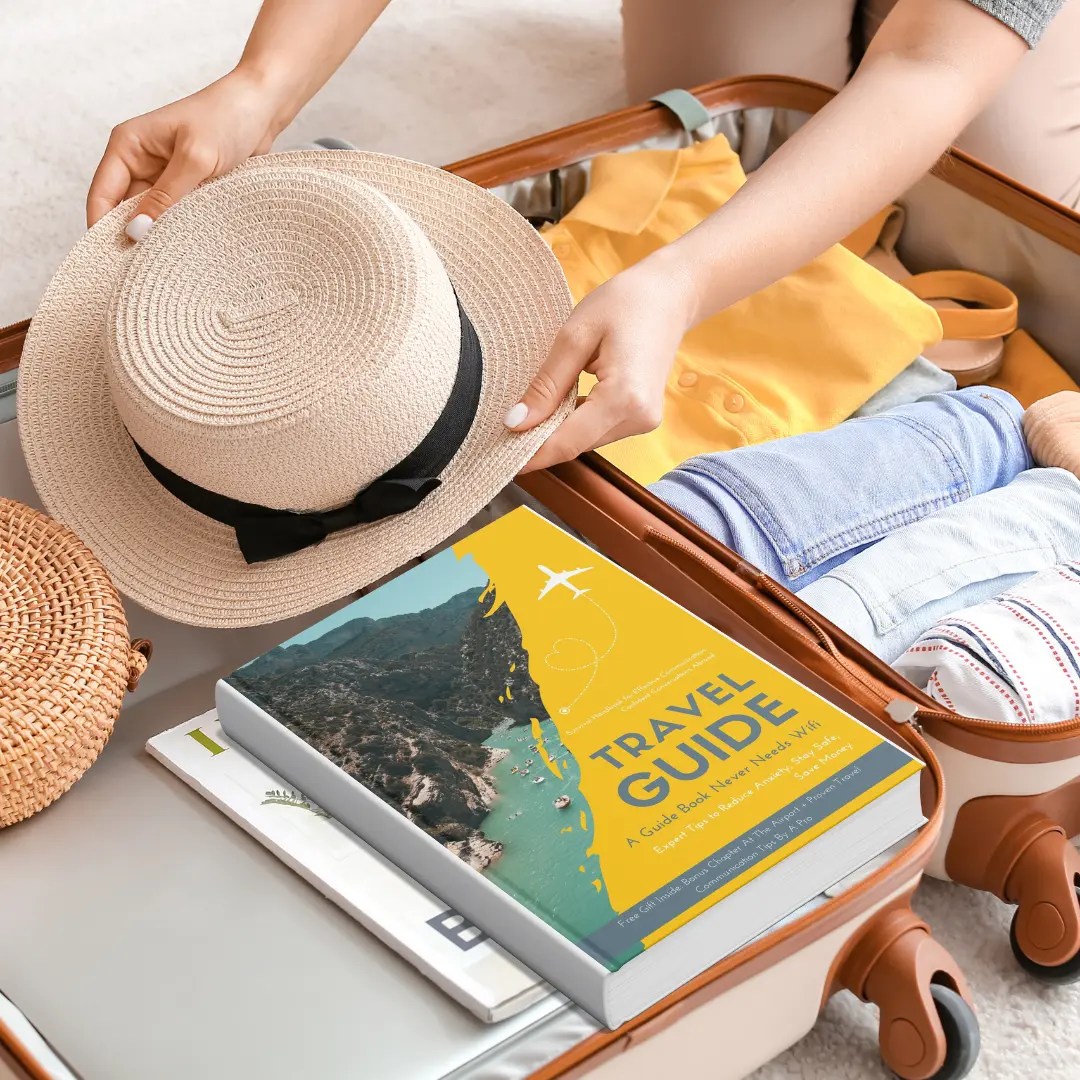
Expert Tips to Reduce Anxiety, Stay Safe, Save Money
Between
Use between for exactly two choices.
Examples:
✅ I can’t decide between the blue and the black jacket.
✅ Choose between these two brands.
Visual idea:
👕 ↔ 👕
Exactly two.
Among
Use among for three or more.
Examples:
✅ She was among many shoppers.
✅ This product is popular among teenagers.
Visual idea:
👥👥👥
Part of a larger group.
With
Think together or included.
Examples:
✅ This jacket comes with a belt.
✅ Coffee comes with free refills.
✅ The phone comes with a charger.
Visual idea:
➕ Included.
Without
Think not included.
Examples:
✅ Coffee without sugar.
✅ Shoes without laces.
✅ I left without buying anything.
Visual idea:
❌➕
Missing something.
By the Checkout
Think of by as next to something.
Examples:
✅ Wait by the checkout.
✅ Stand by the entrance.
✅ There’s a basket by the door.
Visual idea:
🚪🧍
Close beside.
Through
Think of entering one side and exiting another.
Examples:
✅ We walked through the mall.
✅ She went through every aisle.
✅ They walked through the market.
Visual idea:
➡️🏬➡️
Entering and leaving.
Across
Think from one side directly to the other.
Examples:
✅ The bakery is across the street.
✅ The pharmacy is across from the supermarket.
Visual idea:
⬅️🛣️➡️
One side to the opposite side.

A Real-Life Shopping Conversation
Customer:
“Excuse me. I’m looking for a winter jacket.”
Sales assistant:
“They’re in the back of the store.”
Customer:
“Can I try on this blue one?”
Sales assistant:
“Of course. The fitting rooms are over there.”
Customer:
“I’ll pay by credit card.”
Sales assistant:
“Perfect! You can pay at the checkout.”
Notice how naturally these prepositions work together.
Each one describes a different relationship.
Common Mistakes
❌ I am looking this jacket.
✅ I am looking at this jacket.
❌ I am looking at a new phone.
✅ I am looking for a new phone.
❌ I paid by my Visa.
✅ I paid with my Visa.
❌ I tried this jacket.
✅ I tried on this jacket.
❌ I bought it to Walmart.
✅ I bought it from Walmart.
Practice in a Fun Way
The next time you go shopping—even if it’s only online—play a small language game.
Ask yourself questions like:
What am I looking for?
What am I looking at?
What am I paying with?
Where am I?
What comes with this product?
Which item is on sale?
You can even describe your shopping trip aloud.
“I’m walking into the store.”
“I’m looking at the shoes.”
“I’m looking for a backpack.”
“I’m paying with my phone.”
These short descriptions help your brain connect grammar with real experiences.
That is exactly how natural English develops.

From My Experience
Based on my experience as an English learner — and later as a teacher and mentor — I openly share the struggles and mistakes I made, so others don’t have to repeat them. I share the practical tips and methods that helped me move from frustration to confidence.
Expert Advice
1. Think in Pictures
Instead of memorizing lists, imagine movement and relationships.
Your brain remembers images much faster than isolated grammar rules.
2. Practice While Shopping
Every grocery trip, clothing store visit, or online purchase is a free English lesson.
Describe what you are doing as you shop.
3. Learn Small Groups
Don’t study fifty prepositions in one day.
Learn just three or four related patterns together.
For example:
- look at / look for
- pay by / pay with
- in / at / into
FAQ English Prepositions for Shopping
Both are correct.
Use pay by card when talking about the payment method.
Use pay with a card when emphasizing the card you are using.
What’s the difference between “look at” and “look for”?
The preposition on shows that the clothing goes onto your body to see if it fits.
Key Takeaways English Prepositions for Shopping
✔ In = inside a place.
✔ At = one specific point.
✔ Into = movement inside.
✔ Out of = movement outside.
✔ Look at = observe.
✔ Look for = search.
✔ Try on = put clothing onto your body.
✔ Pay by = payment method.
✔ Pay with = what you use to pay.
✔ From = origin.
✔ For = purpose or receiver.
✔ With = included.
✔ Without = not included.
✔ Between = two choices.
✔ Among = many choices.
WHAT TO READ NEXT
Why Essential Prepositions in English Confuse: How to Understand Them Faster
How to Use English Verbs With Prepositions in Real-Life Conversations
Struggling With English Prepositions At Work? Try This Proven Strategy
20 Everyday English Preposition Patterns Used in Real Life
English Prepositions for Directions Stop Guessing Start Understanding Today
English Prepositions for Phone Calls: Overcome Anxiety With Patterns
English Prepositions for School: How to Use Them with Confidence
English Prepositions for Emails. Master Professional Communication Without Mistakes
English Prepositions for Driving: Build Confidence With My Simple System
What to Do Next
The next time you visit your local grocery store, shopping mall, or browse your favorite online shop, don’t worry about speaking perfect English.
Instead, focus on noticing the small prepositions all around you.
Read the signs.
Listen to store employees.
Describe your actions in English.
Oh, you’ve reached the end of this article—thank you for reading all the way to the end! 😊
I hope you now feel more confident using English prepositions for shopping and can see how a single small word can completely change the meaning of a sentence. I also hope the visual explanations helped make these patterns easier to remember.
Before you go, I’d love to invite you to join my newsletter.
It’s a magazine-style newsletter created especially for independent English learners. Every issue reinforces what you’ve already learned while introducing new tips, useful expressions, idioms, and practical English in a fun, relaxed way.
This isn’t another textbook or a course you have to follow step by step. Think of it as a friendly weekly boost that helps you stay consistent, build confidence, and enjoy learning English without feeling overwhelmed.
Every Monday, you’ll receive a simple message in your inbox:
👉 “Hi! How are you doing? Let’s have some fun with English today!”
Because learning English shouldn’t feel like homework. It should be something you look forward to every week.
I can’t wait to see you inside! 😊

Mastering English Doesn’t Have To Be Overwhelming
With my simple step-by-step guidance and helpful tips, you’ll feel supported all the way to fluency—faster than you think!
Join my weekly newsletter to keep your language learning on track!
JOIN THE FAMILY!


