

When Do I Use English Prepositions “In,” “On,” and “At”?
When I was learning languages, prepositions were some of the most difficult words to remember.

What Is the Difference Between In, On, and At?
Think of these prepositions as a simple map:
- In = inside something or within a larger period/place
- On = touching a surface or connected to a day/date
- At = one specific point, place, or time
The same idea works for both place and time. Let’s look at each one step by step.
When Do I Use In?
Use in for something inside an enclosed space or as part of a larger area or longer time period.
Use in for places
- I live in Toronto.
- The keys are in my bag.
- She is in the kitchen.
- We stayed in a small hotel near the airport.
- There are many useful resources in this book.
Use in for time
Use in with months, years, seasons, and parts of the day.
- My birthday is in May.
- I started learning English in 2024.
- We often travel in summer.
- I study English in the morning.
- The meeting is in two hours.
✅ Quick tip: If the place or time feels large, wide, or like a container, choose in.
When Do I Use On?
Use on when something touches a surface. Use it also with days and dates.
Use on for places and surfaces
- Your phone is on the table.
- There is a picture on the wall.
- I wrote the note on a piece of paper.
- We saw the news on the website.
- She is on the bus.
Use on for time
Use on with days of the week, dates, and specific days.
- I have an appointment on Monday.
- The course begins on October 5.
- We visited our friends on the weekend. (Common in Canadian English.)
- I called my mother on my birthday.
✅ Quick tip: If you can imagine something resting on a surface—or you are talking about one particular day—use on.
When Do I Use At?
Use at for a specific point. It is often the smallest and most exact choice.
Use at for places
- I am at work.
- Let’s meet at the dentist’s office.
- She is waiting at the bus stop.
- We met at the airport.
- He is at home today.
Use at for time
Use at with a clock time and certain expressions.
- The class starts at 7:00 p.m.
- I usually wake up at six o’clock.
- Please call me at lunchtime.
- The store is closed at night.
- I will see you at the end of the day.
✅ Quick tip: If you can put a pin on one exact point, use at.
English Prepositions In, On, and At: Quick Comparison
| Use | In | On | At |
|---|---|---|---|
| Place | in a room / in Canada | on the table / on the wall | at work / at the station |
| Time | in July / in the morning | on Tuesday / on May 10 | at 3:00 / at night |
Here is one useful way to remember it:
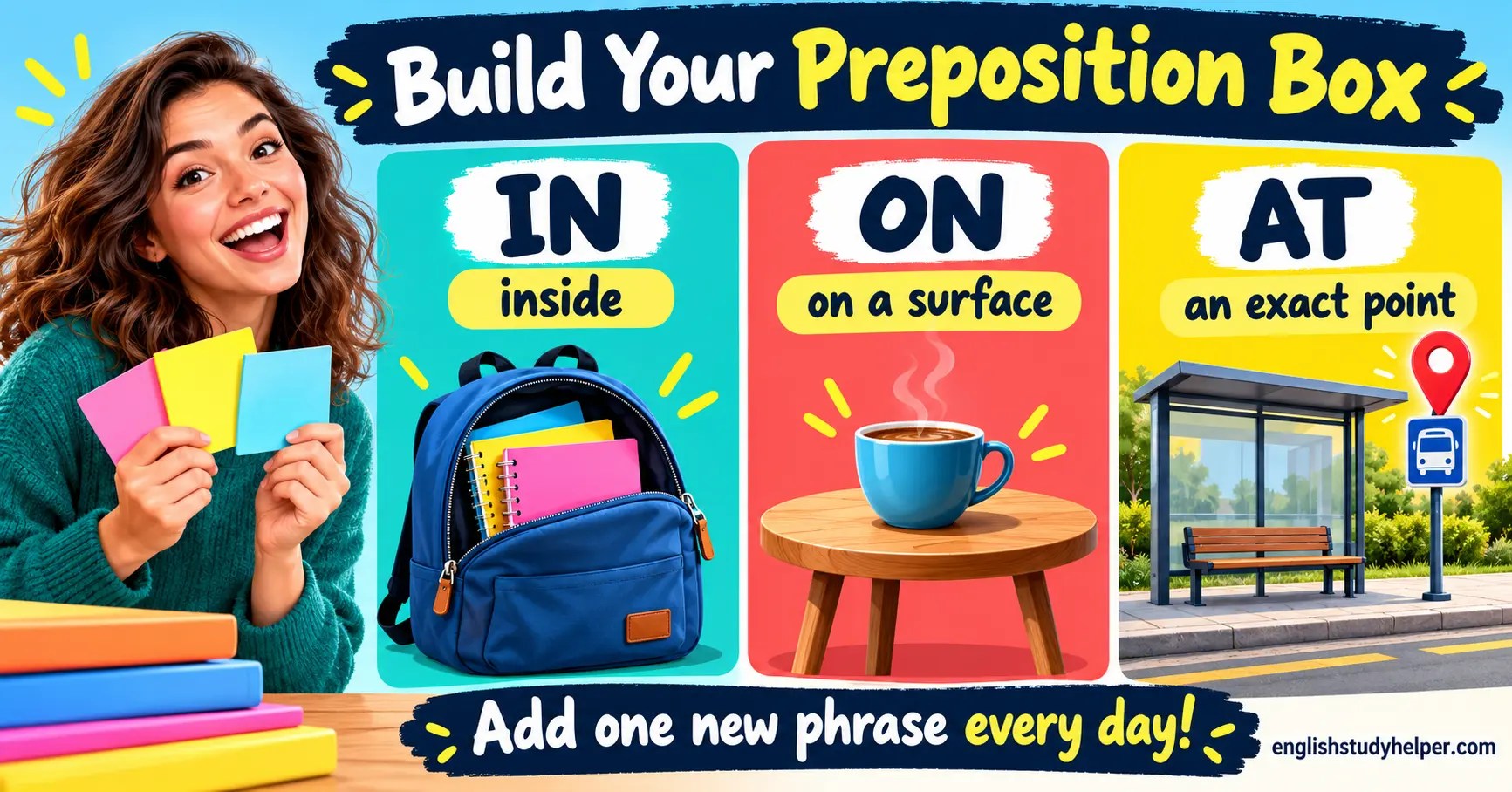
- In = the big box
- On = the surface or the day
- At = the small dot
Common Mistakes With In, On, and At
❌ I was born at 1980.
✅ I was born in 1980.
❌ The meeting is in Monday.
✅ The meeting is on Monday.
❌ Let’s meet on the airport.
✅ Let’s meet at the airport.
❌ I study English at the morning.
✅ I study English in the morning.
❌ My glasses are in the table.
✅ My glasses are on the table.
A Small Exception to Remember
English has a few fixed expressions, so context matters.
- at night but in the morning, in the afternoon, and in the evening
- on the bus/train/plane but in a car/taxi
- at school when you mean the activity or location; in the school when you mean inside the building
For example:
- My children are at school. (They are there as students.)
- I am waiting in the school. (I am inside the building.)
Do not worry about learning every exception today. Notice useful phrases as you read, listen, and speak. Add them to your personal English notebook.
How Can I Practise In, On, and At?
The best way to learn prepositions is to connect them to your real life.
1. Describe Your Day
Write five true sentences using in, on, and at.
- I drink coffee in the morning.
- I work at the dental office.
- I have a meeting on Thursday.
2. Look Around Your Room
Choose five objects and describe where they are.
- The book is on the desk.
- My charger is in my drawer.
- My coat is at the front door.
3. Make a Simple Visual Chart
Create three colourful columns: IN, ON, and AT. Add one new phrase to each column every day. Visual learning helps your brain notice the pattern faster.
4. Practise With ChatGPT
Ask: “Give me ten short sentences with in, on, and at. Leave the preposition blank. Check my answers and explain only the mistakes.”
This gives you quick practice at your own level. You can also ask for examples about your job, travel plans, family life, or daily routine.

5. Use the Phrases in a Real Conversation
Try to use one sentence with each preposition today. Small daily practice builds fluency much faster than studying once in a while.
Key Takeaways
- Use in for larger places and longer periods of time.
- Use on for surfaces, days, and dates.
- Use at for exact places and clock times.
- Learn phrases in context instead of trying to memorize every rule.
- Short, regular practice is the easiest path to confidence.

What to Read Next
Start with the related article. Continue with the updated guides.
10 English Questions Learners Ask Most: Answered by a Language Expert
- How to Use Make and Do Correctly in Everyday English
- Understand The Present Perfect and Past Simple with Proven Tips
- What Is the Difference Between “Say,” “Tell,” “Speak,” “Talk”?
- Silent Letters in English: Why Are Some Letters Silent?
This article is part of a series answering 10 commonly asked English-learning questions. Stay tuned for the rest of the articles covering these topics.
What to Do Next
Choose one activity from this post and do it today. Then save your best example sentences in your Personal Preposition Box.
For more support, explore our guides to confusing English prepositions and build a simple daily English learning routine that works for your life.
If you’re ready to move forward, check out my programs and guides where I show you exactly how to create a clear system, use visuals, and make real progress in English—without overwhelm
That is exactly what the Roadmap to Fluency philosophy is about:
Build strong foundations.
Use smart systems.
Grow step by step.
FAQ: English Prepositions In, On, and At
In Canadian and American English, we usually say on the weekend. In British English, people often say at the weekend.
These are fixed English expressions. Learn them as complete phrases: at night, in the morning, in the afternoon, and in the evening.
Do I Use In or At for a City?
Use in for a city: “I live in Toronto.” Use at for a specific place in the city: “I am at Union Station.”
Usually say on the bus, on the train, or on the plane. For smaller private vehicles, say in a car or in a taxi
Use the visual memory trick: in = big box, on = surface, at = small dot. Then practise with sentences about your own life.
Mastering English Doesn’t Have To Be Overwhelming
With my simple step-by-step guidance and helpful tips, you’ll feel supported all the way to fluency—faster than you think!


