

What Is the Difference Between “See,” “Look,” and “Watch”?
Have you ever wondered whether to say “I saw the movie,” “I looked at the movie,” or “I watched the movie”? These three verbs are connected to our eyes, but we use them in different ways.

How are “see,” “look,” and “watch” different?
See: notice something with your eyes
We use see when something comes into our sight. Seeing can happen naturally, without us trying.
- I can see the mountains from my window.
- Did you see the message on your phone?
- We saw a beautiful bird in the garden.
See is often used for general awareness or noticing. We don’t usually say “I see at the picture.”
Look: direct your eyes toward something
We use look when we choose to turn or direct our eyes toward something. When we name the thing we are looking at, we usually say look at.
- Please look at this photograph.
- She looked at the clock.
- He looked in the mirror.
Think of look as an action: you make an effort to focus your eyes in a certain direction.
Watch: pay attention to something over time
We use watch when we look at something for a period of time, especially when it is moving or changing.
- We watched a movie last night.
- The children watched the birds flying.
- I like to watch the rain from my window.
Watching usually takes more attention and time than simply seeing something.
Compare the three verbs
Imagine a bird outside your window:
- You see a bird. It comes into your sight.
- You look at the bird. You turn your eyes toward it.
- You watch the bird. You follow it as it flies from branch to branch.
The same idea works with other examples:
- I saw my friend at the store. (I noticed her.)
- I looked at my friend’s new photos. (I directed my eyes toward them.)
- I watched my friend play tennis. (I followed the action for a while.)
Common phrases with these verbs
Some expressions are especially useful to learn as complete phrases:
- see a doctor: I need to see a doctor about my cough.
- look at something: Look at the words on this page.
- look for something: I’m looking for my keys.
- watch TV: We watched TV after dinner.
- watch a game: They watched the hockey game together.
Notice that we say look at the picture, but watch a movie. Learning the whole phrase can help you choose the right verb.

From My Experience
Based on my experience as an English learner — and later as a teacher and mentor — I openly share the struggles and mistakes I made, so others don’t have to repeat them. I share the practical tips and methods that helped me move from frustration to confidence.
As a language learner and teacher, I’ve learned that small differences between common words can be confusing, even when the basic meaning seems clear.
It helps me to connect each verb with an action: see is noticing, look is directing your eyes, and watch is paying attention over time.
When I practise with real examples from everyday life, the difference becomes easier to remember.
Tips from My Experience: How to Remember “See,” “Look,” and “Watch”
I find it easier to remember these verbs when I connect each one to an action instead of memorizing a long rule.
- See = notice. Something comes into your sight: I can see a bird.
- Look = turn your eyes toward it. Remember look at: Look at that bird!
- Watch = follow it for a while. The bird moves, and you follow the action: I watched the bird fly away.
Try using the same subject to practise all three verbs. For example: I saw my neighbour. I looked at her new bicycle. I watched her ride away.
It also helps to learn useful phrases as complete pieces, such as see a doctor, look at a picture, and watch a movie. Make up a few sentences about things you see and do each day. Short, personal examples are easier to remember and use later.
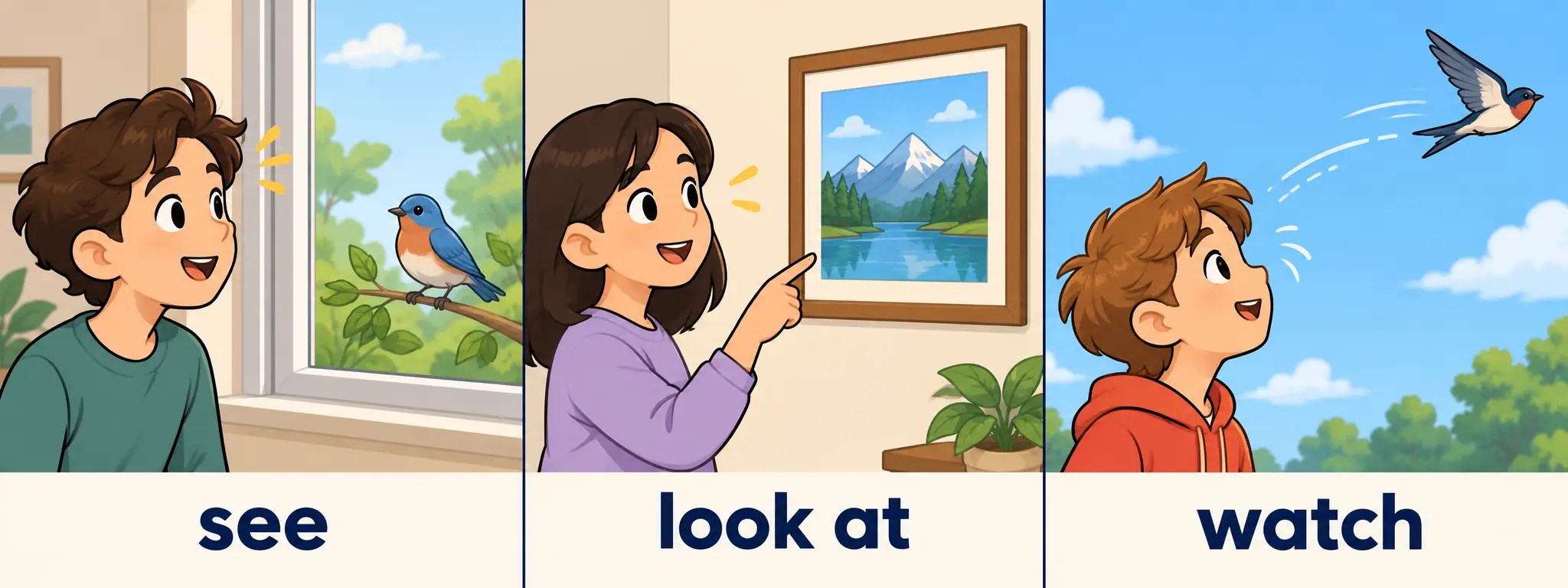
Use a simple visual
Draw three small pictures: eyes noticing a bird, a person looking at a picture, and someone watching a bird fly. Add see, look at, and watch under the matching pictures. A visual reminder can make the differences easier to recall.
Practise with AI
Ask an AI tool to give you short practice sentences with see, look, and watch. You can try this prompt:
Give me five easy sentences with a blank. I will choose see, look, or watch. Check my answers and explain any mistakes simply.
You can also ask the AI to create a short dialogue using all three verbs.

In this guide, you’ll meet Ai-Va, an AI-powered language learning assistant, designed to help you learn English smarter—not harder.
GUIDE: AI The New Era of Language Learning
Discover how to use AI and a proven system to study faster and remember forever.
Who is this guide for?
- Learners who feel language learning still isn’t sticking
- Anyone aiming for fluency but tired of ineffective drills
- Teachers seeking smarter tools for real progress
- Professionals who need practical English for work
- Newcomers and travelers using English every day
- Parents supporting learning at home
Try the Dripping Method
Practise for just a few minutes at a time, and return to the verbs over several days. On the first day, learn the meanings. The next day, review your three example sentences. Later, try making new sentences without looking at your notes.
To learn more about this proven method, check this article.
Key takeaways
- See means to notice something with your eyes.
- Look means to direct your eyes toward something. Use look at before the thing you are viewing.
- Watch means to pay attention to something for a period of time, often while it moves or changes.
Frequently asked questions
Say watch TV when you mean that you are viewing a program. You can say look at the TV when you mean that you are directing your eyes toward the television itself.
Look is directing your eyes toward something. Watch means continuing to look and pay attention, usually for a while.
Yes. “ I saw a movie” means you went to see it or experienced it. I watched a movie emphasizes the activity of viewing it.

What to Read Next
Start with the related article. Continue with the updated guides.
10 English Questions Learners Ask Most: Answered by a Language Expert
- How to Use Make and Do Correctly in Everyday English
- Understand The Present Perfect and Past Simple with Proven Tips
- What Is the Difference Between “Say,” “Tell,” “Speak,” “Talk”?
- Silent Letters in English: Why Are Some Letters Silent?
- What Are Phrasal Verbs and How Do I Learn Them?
- When Do I Use English Prepositions “In,” “On,” and “At”?
- How Can I Sound More Natural When Speaking English
This article is part of a series answering 10 commonly asked English-learning questions. Stay tuned for the rest of the articles covering these topics.
What to do next
Choose one object near you and make three sentences with see, look at, and watch. You may need to imagine movement for the last sentence. Practising with your own examples will help you remember which verb fits.
For extra support, explore my guides to confusing English prepositions and create a simple daily learning routine that fits your life.
Ready to take the next step? Explore my programs and guides to build a clear learning system, use visuals effectively, and make steady progress in English—without feeling overwhelmed.
That is exactly what the Roadmap to Fluency philosophy is about:
Build strong foundations.
Use smart systems.
Grow step by step.

Mastering English Doesn’t Have To Be Overwhelming
With my simple step-by-step guidance and helpful tips, you’ll feel supported all the way to fluency—faster than you think!
Join my weekly newsletter to keep your language learning on track!
JOIN THE FAMILY!


